

Commercial insurance prospecting works when it is a repeatable system: a defined niche, a list you build on purpose, a short qualification routine, and follow-up that starts within minutes and continues for months. Most agents do not lack prospects. They lack a process that turns a name into a conversation before the renewal date passes. We built our Policy Engine around that problem: verified commercial leads at $15 each, connected to a CRM that follows up by email and, where eligible, by text, and tracks every appointment.
TL;DR
- Prospecting means looking for potential buyers of insurance. In commercial lines the clock that matters is the renewal date, so you need a pipeline of prospects well before it.
- Pick one niche, build records with owner, size, lines and renewal month, and qualify on a few questions before you spend time on a quote.
- Speed and consistency decide who wins the conversation. Respond to inbound inquiries in minutes and keep a written follow-up cadence over months.
- Email, calls and texts each carry U.S. rules. Business-to-business calls are largely exempt from the national Do Not Call registry, but email is not exempt from CAN-SPAM.
- Our commercial leads are $15 per verified lead on a one-off basis, with email follow-up starting at $79.
Table of Contents
- What prospecting means in commercial insurance
- Step 1: Choose a niche before you build a list
- Step 2: Build prospect records, not just lists
- Step 3: Qualify on a handful of questions
- Step 4: Choose channels that fit the prospect
- Step 5: Respond fast, then keep following up
- A first-contact script that works for commercial prospects
- The U.S. rules for calls, texts and email
- Free and low-cost lead sources, and how to judge quality
- What the system looks like in one place
- How we can help
- FAQ
- Sources
What prospecting means in commercial insurance
The insurance glossary at IRMI defines prospecting as the act of looking for potential buyers of insurance, with marketing as a synonym. In personal lines that often means volume: many households, quick decisions, small premiums. Commercial prospecting is slower and narrower. You are looking for a business owner, a controller or an operations manager who has a policy in force, a renewal on the calendar and a reason to look at someone new.
That changes three things.
- Timing is set by the renewal. A prospect who is 30 days from renewal has little room to switch. A prospect who is 120 days out has time to hand you loss runs and listen.
- The sale needs information. You cannot quote a contractor, a restaurant or a trucking company from a name and a phone number. You need operations, payroll or revenue, claims history and contract requirements.
- The cycle is long. Many commercial buyers say no this year and yes next year. A system that remembers them is worth more than a burst of calls that stops.
If you have ever sat with a list of 200 businesses and no idea who to call first, the problem was not effort. It was the lack of a way to rank them.
Step 1: Choose a niche before you build a list
General commercial prospecting is hard to do well because every class of business has different exposures, different questions and different carriers. A niche lets you speak the prospect's language on the first call. A plumber hears about tools, completed operations and subcontractor certificates. A restaurant owner hears about liquor liability and equipment breakdown.
Pick a niche using three filters:
- Appetite. Do your carriers want this class, and at what premium size?
- Reachability. Can you find owners or decision makers by name?
- Repeat exposure. Does the class need the same coverage year after year, so one good account teaches you how to win ten more?
Write the niche down in one line, for example: "Trades contractors with 5 to 50 employees in our state." Everything after this step, the list, the script, the follow-up, gets easier to write once that line exists.
Step 2: Build prospect records, not just lists
A list is names. A record is what lets you decide whether to call. For each prospect, capture:
- Business name, owner or decision maker, direct phone and email
- Class of business or NAICS code, which is the federal number that classifies industries
- Employee count or estimated revenue, enough to estimate premium size
- Current carrier or agent, if known
- Renewal month
- Source, so you can learn which channels produce appointments
Where do the names come from? The sources agents commonly use are public: state business registration filings, contractor licensing boards, chambers of commerce, trade associations, LinkedIn and commercial real estate transactions. Each is cheap in dollars and expensive in hours. Someone has to find the entries, clean them and keep them current.
That is the work our verified leads are designed to take off your desk. Our commercial leads are priced at $15 per verified lead, and each one lands in the CRM pipeline rather than a spreadsheet, so the record, the follow-up and the appointment status live in one place. For comparison, our published per-lead prices for other lines are $6 for P&C, $8 for life, $9 for Medicare, $12 for annuities and $28 for crop.
Step 3: Qualify on a handful of questions
Qualification protects your calendar. A short routine, used the same way every time, stops you from preparing a proposal for a business that was never going to move. Use these seven questions, in roughly this order:
- When does the current policy renew?
- Which lines do you carry, and which are you missing?
- What does the business do, in plain terms?
- How big is it: payroll, revenue, vehicles, locations?
- Have there been claims in the last three to five years?
- Do customers or landlords require certificates of insurance or additional insured status?
- Who else is involved in the decision?
Then decide quickly. No renewal date you can work with, no willingness to share loss runs (the carrier's record of past claims) and no access to the person who decides are three signals to move the prospect to a slower nurture track instead of a quote. Moving a prospect to nurture is not rejection. It is how you keep the name alive for the renewal that does fit.
When the first conversation goes well, the next goal is not a sale. It is a scheduled fact-finding meeting where you collect declarations pages, loss runs and operations details. Our guide to insurance appointment setting covers how to get from a first reply to a booked meeting.
Step 4: Choose channels that fit the prospect
No single channel carries a commercial book. Each has a job.
| Channel | Best for | Watch out for |
|---|---|---|
| Phone | Warm leads, renewal-timed outreach, decision makers who answer | Low answer rates on cold lists; calling rules |
| Cadence, sharing a short checklist or coverage note, staying visible for months | Must meet CAN-SPAM rules | |
| Text | Confirming appointments, short replies to inbound inquiries | Needs the right consent |
| LinkedIn and referrals | Owners and finance roles in a niche | Slow, relationship-based |
| Paid social ads | Generating inbound inquiries on a schedule | Needs fast follow-up and clean targeting |
Owners of small businesses are busy and often away from a desk. A mix of one call, one email and, where consent exists, one text gives them three easy ways to reply. If you want depth on the email side, our piece on automated email follow-up shows how a sequence is built.
Step 5: Respond fast, then keep following up
Two habits separate agents who convert from agents who collect leads.
Speed. An inquiry that sits for a day is competing with every other agent the business owner contacted. We designed our follow-up system to contact a prospect within five minutes of an inquiry, which is the standard we recommend you hold yourself to during business hours, whether you use our CRM or not.
Cadence. Commercial buyers rarely decide on the first touch. A written cadence stops you from relying on memory. A workable pattern over about a month looks like this:
- Day 1: call and a short email
- Day 3: second call
- Day 5: email with something useful, such as a one-page list of coverages that businesses in the niche often miss
- Day 8: third call
- Day 12: another useful email
- Day 20: final call
- Day 25: a short closing email that leaves the door open
After that, move the record to a slower track keyed to the renewal month, so you reappear four to five months before it.
The point of the cadence is not pressure. It is that every prospect gets the same professional treatment, and no promising lead goes quiet because you were at a client meeting. In our CRM, follow-up emails and eligible texts go out automatically, and pipeline and appointment tracking show you who replied, who booked and who needs a call.
A first-contact script that works for commercial prospects
Keep the first call under two minutes and built around one question. Here is the structure:
- Who you are, in one sentence. "This is Dana with Hartwell Insurance. We work with independent electrical contractors in the area."
- Why you are calling. "I am reaching out because many contractors are surprised by what their policy does and does not cover when a customer asks for an additional insured endorsement."
- One question. "When does your general liability renew?"
- A small next step. "If it is a few months out, can I send you a one-page review checklist and call you in two weeks?"
Notice what is missing: a pitch about price. At this stage you are asking for a renewal month and permission to follow up. The name and company above are made up for illustration.
The U.S. rules for calls, texts and email
Prospecting is regulated, and the rules differ by channel. This is a summary for orientation, not legal advice. For your own program, check with your compliance officer or attorney and with your carrier and state department of insurance.
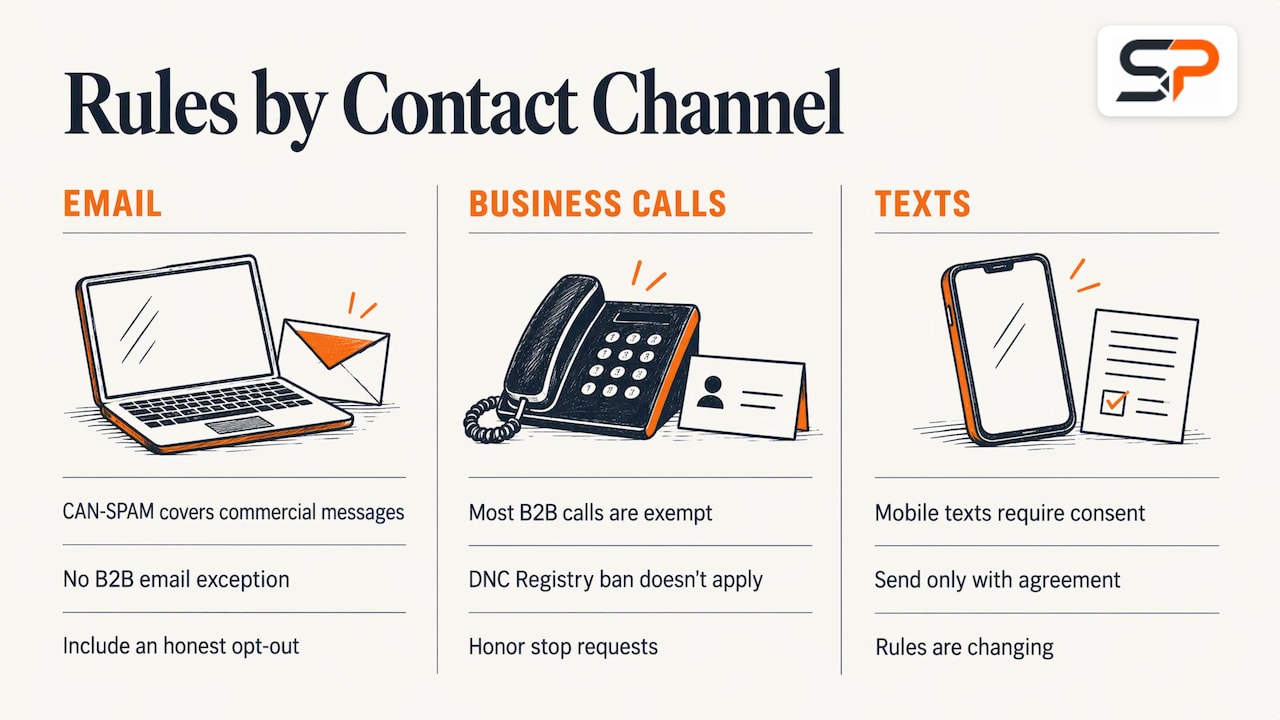
Email. The FTC states that CAN-SPAM covers all commercial messages and makes no exception for business-to-business email. In practice that means accurate From, To and Reply-To information, subject lines that reflect the content, and an honest way to opt out that you honor. A prospecting email to a business owner is a commercial message.
Calls to businesses. The FTC's guidance on the Telemarketing Sales Rule says most calls between a telemarketer and a business are exempt, and that the prohibition on calling numbers on the Do Not Call Registry does not apply to business-to-business calls. Your prospect is a business, which is why cold calling remains a standard commercial tactic. Keep your own do-not-call list for anyone who asks you to stop, and be careful when a sole proprietor answers on a personal cell phone.
Texts. Text messaging to mobile numbers carries consent requirements under federal law, and the rules and court interpretations have been changing. Treat texts as something you send to people who have asked or agreed to hear from you. Our texting follow-up is consent-based and sent only where eligible, which is why the starter pack with texting is a separate option.
The practical habit is the same for every channel: record where each contact came from, what permission exists, and when someone opted out.
Free and low-cost lead sources, and how to judge quality
Public filings, licensing boards, chambers of commerce and your own client referrals cost nothing but time. They are a sensible start, and the quality test is simple: can you reach a named decision maker, and can you tell roughly how large the business is?
Whether a lead source is worth paying for comes down to cost per appointment and cost per bound policy, not cost per name. Our guide to calculating cost per lead walks through the arithmetic. A worked example with illustrative numbers:
- You buy 20 verified commercial leads at $15 each, a total of $300.
- Six reply and four agree to a fact-finding meeting.
- One becomes a client.
Your cost per appointment is $75 and your cost per client is $300 before your own time. Whether that is a good trade depends on your average commission and retention. Run the same math on your free sources, counting the hours at what your time is worth, and you will see where your effort pays.
The numbers above are an example, not a forecast of results.
What the system looks like in one place
Agents who prospect well tend to have the same five parts in place:
- A niche statement
- Records with renewal month and size
- A seven-question qualification routine
- A written follow-up cadence across email, calls and consented texts
- A pipeline view showing every prospect's stage
Parts 1 and 3 are decisions you make once. Parts 2, 4 and 5 are where hours disappear, and they are the parts our CRM is built to handle: lead verification so you spend less time on invalid inquiries, automated follow-up, and appointment tracking.
How we can help
The Policy Engine gives insurance agents verified leads and a CRM pipeline in one starting purchase. The Email Starter is $79 one-off, and the Email + Text Starter is $97 one-off. Verified leads are charged per lead: $15 each for commercial, with other lines priced separately on the same page. If you want to run your own paid social campaigns, our Done-for-You Meta Ads Setup is $297 one-off, and you keep control of your own ad account and pay Meta directly.

See the details and pricing on the Policy Engine page, or schedule an intro call to talk through your niche and your follow-up process.
If you run an HVAC company, a cleaning business or a managed service provider, the same principles apply: a defined niche, fast response and a follow-up cadence. Our Contractor Engine, cleaning plans and MSP Growth offer pages cover those businesses, and our HVAC lead generation guide shows the process in a field-service setting.
FAQ
What does prospecting mean in commercial insurance?
It means looking for potential buyers of insurance, which IRMI's glossary lists as a definition of the term. In commercial lines it usually means identifying businesses in a niche, finding the decision maker, learning the renewal date and starting a conversation well before that date.
Where can I find free leads for commercial insurance?
Start with public sources: state business registration filings, contractor licensing boards, chambers of commerce, trade associations and referrals from current clients. They cost no money but take research time. Verified leads, such as our $15 commercial leads, trade money for that time.
How fast should I follow up on a commercial inquiry?
As fast as you can during business hours. We aim for contact within five minutes of an inquiry, and a prompt call, email or eligible text beats a reply the next day. Then continue with a written cadence rather than relying on memory.
Can I cold call businesses for insurance?
The FTC says the Do Not Call Registry prohibition does not apply to business-to-business calls, and most calls between a telemarketer and a business are exempt from the Telemarketing Sales Rule. Honor any request to stop calling, and have your compliance contact review your script and call lists.
Do email prospecting rules apply to business owners?
Yes. The FTC states that CAN-SPAM makes no exception for business-to-business email, so honest headers, accurate subject lines and a working opt-out apply to messages sent to business owners.
Sources
- IRMI: prospecting, insurance definition
- FTC: CAN-SPAM Act compliance guide for business
- FTC: Complying with the Telemarketing Sales Rule