

Managed lead generation means someone else runs the work that gets prospects to raise their hand, then checks and hands them to you so you can sell. For an insurance agent, an HVAC contractor, a commercial cleaner or an MSP, the part that decides the result is what happens after the inquiry: how fast the lead is contacted, whether it is real, and whether anyone follows up. We built our service around that point. Industry-specific campaigns feed a CRM that verifies the lead and starts follow-up, aiming to contact each inquiry within five minutes.
TL;DR
- Managed (or outsourced) lead generation hands off targeting, ad campaigns, inquiry capture, qualification and first follow-up. You keep the conversation and the close.
- Judge a provider by what lands in your pipeline: verified leads, speed of first contact, and clear records of consent.
- Pricing comes in three shapes: a fixed fee per verified lead, a flat campaign or setup fee, or a retainer. Ask what the ad spend is on top.
- Email and text follow-up carries legal duties under CAN-SPAM and the TCPA. A provider that handles consent properly protects you.
- Keep the sales call, the quote and the relationship in-house. Outsource the repetitive front end.
Table of Contents
- What managed lead generation actually covers
- Why the first few minutes decide so much
- What it looks like by industry
- What managed lead generation costs
- How to tell whether the leads are good
- The compliance side: email and text follow-up
- What to outsource and what to keep
- How to choose a provider
- Where our service fits
- FAQ
- Sources
What managed lead generation actually covers
The phrase gets used loosely, so it helps to break it into the jobs involved. A managed service takes some or all of these off your plate:
- Targeting. Deciding who sees the offer: homeowners with aging systems, small businesses renewing a policy, office managers shopping for a cleaning contract.
- Campaigns. Building the ads and landing pages that produce inquiries. For local service firms this is most often paid social or search.
- Inquiry capture. Getting the form, call or message into one place instead of three inboxes.
- Verification and qualification. Filtering out fake contacts, duplicates, wrong areas and people who are not buying.
- Routing and follow-up. Getting the lead to the right person, quickly, with the first email or text already sent.
- Tracking. Showing which leads became appointments and which became customers.
Providers differ in how much of this they own. A list seller does step 3 at best. A full managed program covers all six. When comparing options, ask which of these jobs are included in the price and which are left to you.
Why the first few minutes decide so much
Most small service businesses do not lose leads because the ads were bad. They lose them because nobody called back while the prospect was still looking. A person who fills out a form for a furnace quote or a Medicare question has often sent the same request to several businesses. The first reply sets the tone for the conversation.
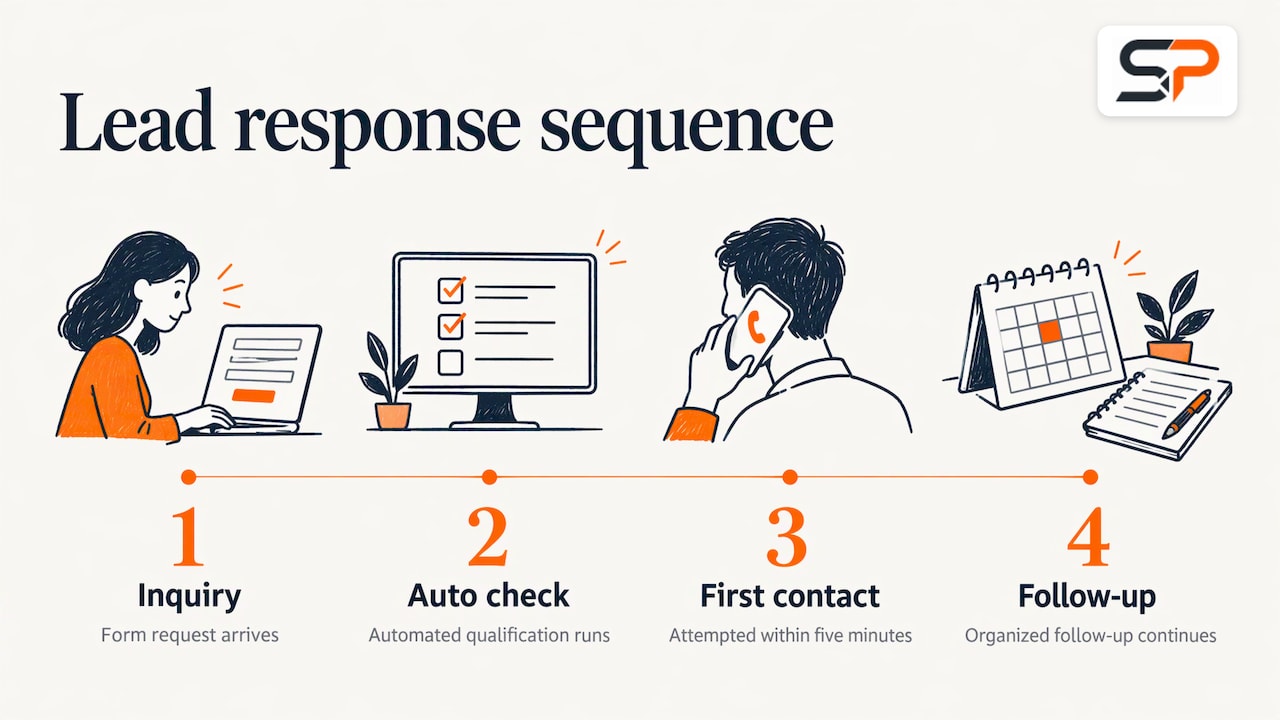
That is why speed is built into our service rather than treated as an afterthought. The aim is to contact each inquiry within five minutes, with automated qualification checks and organized follow-up behind it. If you run a crew, sit in client meetings or are on a roof, you cannot do that by hand. A system can.
If you want to see how this plays out for one trade, our guide to HVAC lead generation walks through the qualification and response steps in detail. For the email side, see automated email follow-up.
What it looks like by industry
The same machinery gets tuned differently for each business.
Insurance agents
Insurance leads are sold by line, and value varies widely. A property and casualty inquiry is a different animal from a crop or commercial one, and pricing should reflect that. What matters is that the lead is verified before you pay for it, and that follow-up starts before the prospect forgets the form. Appointment setting is the next bottleneck; our insurance appointment setting guide covers it, and the commercial insurance prospecting piece covers the business-lines side.
HVAC contractors
HVAC demand is seasonal and urgent. A no-heat call in January cannot wait until tomorrow. Contractors need fast, qualified leads in their service area, with the lead tied to an appointment on the calendar. Our Contractor Engine pairs targeted campaigns with a CRM that tracks each lead through to the job.
Commercial cleaning companies
Cleaning contracts are won on follow-up. A walkthrough request goes quiet quickly if nobody checks in. What these businesses need most is an organized pipeline: who asked, who was contacted, who has a walkthrough booked, who needs a proposal. Our cleaning plans are built for that, and we offer optional AI voice agents for cleaning businesses.
Managed service providers
MSPs sell on trust and sell recurring contracts, so consistent engagement matters more than volume. A steady rhythm of follow-up with prospects who are not ready yet is what turns a cold inquiry into a managed-services agreement. Our MSP Growth offer is aimed at exactly that.
What managed lead generation costs
There is no single price, because providers charge in different ways. The three common models:
| Model | How it works | Best when |
|---|---|---|
| Per verified lead | You pay a fixed fee for each lead that passes verification | You want cost tied to results |
| Flat setup or campaign fee | A one-time fee to build and launch campaigns | You want to own your ad account and control spend |
| Retainer | A monthly fee for ongoing management | You want hands-off, continuous campaigns |
Whatever the model, ask two questions. First, who pays the ad platform? Second, what counts as a billable lead? A "lead" that is a bad phone number is not a lead.
Our published prices follow the first two models:
- Email starter: $79 one-off. Email plus text starter: $97 one-off.
- Verified insurance leads, per lead: P&C $6, Life $8, Medicare $9, Annuities $12, Commercial $15, Crop $28.
- Done-for-You Meta Ads setup: $297 one-off.
With our approach you control your own ad accounts and pay Meta directly, and managed campaign services are available if you would rather not run them yourself. Prices for Contractor Engine, the cleaning plans and MSP Growth are not published; the pages above explain what each includes.
To see whether any lead price works for your business, work backward from your own numbers. Our cost per lead guide shows how to calculate it and compare it with what a customer is worth to you.
How to tell whether the leads are good
A cheap lead is expensive if it never answers the phone. Judge a managed program on a short list of measures, in the order they show up:
- Accepted-lead rate. Of the leads delivered, how many were real, in your area and in your line of business?
- Speed to first contact. How long between the inquiry and the first email, text or call? Ask for the actual log, not an average.
- Contact rate. How many leads responded at all?
- Appointments set. How many became a booked quote, walkthrough or call?
- Closed business. How many paid, and what did they pay?
The early measures show up within days. Closed revenue takes weeks or months, depending on how long your buyers take to decide. An annuity or commercial insurance buyer may need a month or more; a broken AC unit may close the same day. Match your patience to your sales cycle, and compare cost per closed customer, not just cost per lead.
A CRM that logs every message, note and stage change makes this easy. It also tells you where the process leaks. If leads are accepted and contacted but never book, the problem is the offer or the pitch, not the lead source.
The compliance side: email and text follow-up
Fast follow-up usually means automated email and text, and both are regulated in the US. This is where a careless provider can create real risk for you, so it is worth understanding the basics.
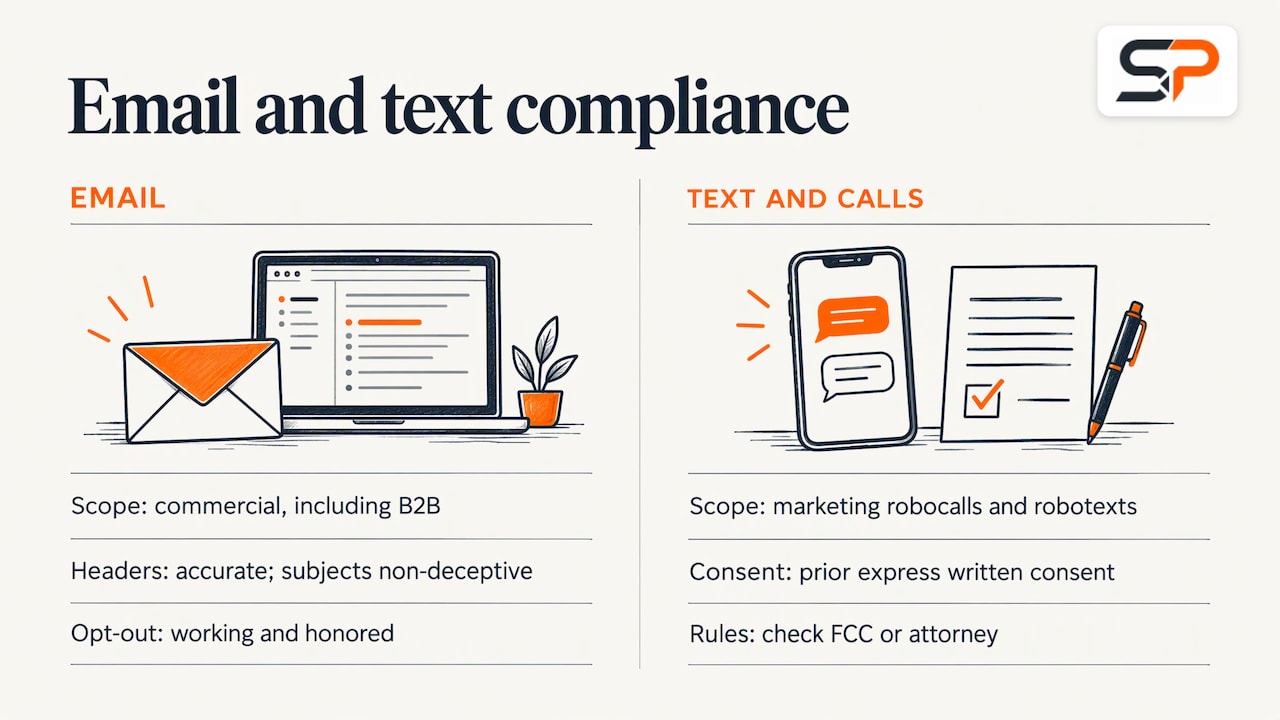
Email. The CAN-SPAM Act covers commercial email, and the FTC's compliance guide states that it makes no exception for business-to-business messages. It requires accurate header information and non-deceptive subject lines. Every message also needs a working way to opt out, which you must honor. Your emails should carry these elements every time.
Text and calls. Under the Telephone Consumer Protection Act (TCPA), marketing robocalls and robotexts require the consumer's prior express written consent, as the FCC's consumer guidance describes. The rules around consent and opt-outs have been shifting through court decisions and FCC orders, so check the FCC's current rules or ask your attorney before you launch text campaigns.
This is why our follow-up is consent-based, and why text is offered where it is eligible. The Email Starter at $79 covers email; the Email + Text Starter at $97 adds text. Our Terms of Service and Privacy Policy set out how we handle data.
What to outsource and what to keep
A useful rule: outsource what is repetitive and time-sensitive, keep what depends on your judgment and your relationships.
Outsource
- Campaign setup and ad management
- Lead verification and filtering
- First-touch email and text follow-up
- Pipeline tracking and appointment reminders
Keep
- The quote, the proposal and the sales conversation
- Pricing decisions and underwriting or scoping judgment
- Customer relationships after the sale
- Final say on which markets and services to pursue
For an owner-operator, this split matters most. You do not need another full-time hire to watch the inbox. You need the front end to run itself so your day goes to the people who are ready to talk.
How to choose a provider
Whether you work with us or look at the market, use the same checklist:
- Industry fit. Does the provider work in your trade, with campaigns written for your buyers?
- Verification. Is a lead checked before you are billed for it?
- Speed. Is first contact automatic, and how fast?
- Ownership. Do you own the ad account, the data and the contact list?
- Pricing clarity. Is the cost per lead or per campaign stated, along with the ad spend?
- Consent handling. Are email and text follow-up built around opt-in and opt-out?
- Tracking. Can you see every lead from inquiry to close?
A provider that answers all seven plainly is one you can plan around.
Where our service fits
Secure Pipeline AI, the Advantage Engine, ties industry-specific lead generation to lead verification, a CRM pipeline and rapid, consent-based follow-up. Insurance agents can start with the Policy Engine, where verified leads are priced per line and starter packs include lead credit. You can also schedule the Policy Engine intro call to see how it works.

HVAC contractors can look at the Contractor Engine overview. Cleaning companies and MSPs can go to the cleaning plans or MSP Growth. The main site has the full picture.
FAQ
What is the difference between managed and outsourced lead generation?
In practice, the terms describe the same idea: a provider runs the lead generation work for you. "Managed" usually stresses ongoing campaign management, while "outsourced" stresses handing the function off entirely. What matters is which tasks are covered, from ads through to follow-up.
How much should I pay for a lead?
It depends on your industry and what a customer is worth. A fair price is one where the cost per closed customer sits comfortably below the profit that customer brings. Our per-lead fees for insurance run from $6 for P&C to $28 for Crop, and our cost per lead guide shows how to run the math.
Will I own my ad account?
With our service, yes. You control your own ad accounts and pay Meta directly. If you would rather not manage campaigns, managed campaign services are available, including the Done-for-You Meta Ads setup at $297 one-off.
Do I need consent to text leads?
For marketing texts sent with automated systems, federal rules require prior express written consent. Because the rules change, confirm the current requirements with the FCC or your attorney before you send. Our follow-up is consent-based.
Sources
- CAN-SPAM Act: A Compliance Guide for Business, FTC
- FCC Consumer and Governmental Affairs Bureau guidance on TCPA consent