

You lower customer acquisition cost (CAC) by doing two things at once: paying only for leads that can actually buy, and converting more of the leads you already have. For an insurance agency, an HVAC contractor, a commercial cleaning company or a managed service provider (MSP), most of the savings sit in lead quality and follow-up speed, not in a smaller ad budget. Our system is built around that idea: industry-specific lead generation, lead verification, and follow-up that reaches a new inquiry within five minutes.
This guide shows how to calculate your real CAC, where the waste usually hides, and what to change first.
TL;DR
- CAC is total sales and marketing spend divided by new customers in the same period. Write down what you count so the number stays comparable.
- Cost per lead is a weak yardrstick on its own. Cost per qualified lead and cost per customer tell you whether a channel pays.
- Speed matters: a widely cited MIT study found leads contacted within five minutes were far more likely to be reached and qualified than leads contacted at thirty minutes.
- A lower CAC only helps if lifetime value holds. Check CAC against customer value and payback, not in isolation.
- Verified leads plus automated, consent-based follow-up attack both halves of the equation: fewer wasted leads going in, more customers coming out.
Table of Contents
- Start with an honest CAC number
- Where acquisition money leaks
- Fix targeting before you fix budgets
- A worked example: what verified leads do to CAC
- Rank your channels by cost per customer
- Check that a lower CAC is a better CAC
- Build the follow-up engine once, then let it run
- Where our system fits
- What to do this month
- FAQ
- Sources
Start with an honest CAC number
You cannot lower a number you calculate three different ways. TechTarget gives the basic formula: total sales and marketing expenses divided by the customers acquired in the period. Its example is $15,000 divided by 150 customers, or $100 each. A fuller version adds wages, software, professional services and overhead, and the same inputs produce $167.
Both are valid. What matters is choosing one and sticking with it. The American Marketing Association advises documenting your customer definition and cost scope next to the figure, so everyone who reads it shares the same baseline before you start optimizing.
For a service business, the practical version looks like this:
- Pick a period. Monthly works for HVAC and cleaning, where jobs close in days or weeks. Insurance and MSP deals with longer cycles need a quarter so spend and customers line up.
- Add acquisition costs only. Ad spend, lead fees, the CRM, the commissions or salary time spent chasing new business. Leave out the cost of serving existing clients.
- Divide by new paying customers. Not leads, not appointments: customers who signed or booked a job.
Shopify's CAC guide follows the same logic, with an example of $250,000 in quarterly acquisition spend and 250 new subscribers producing a $1,000 CAC.
If you want the lead-level version of this math first, our guide to calculating cost per lead walks through it.
Where acquisition money leaks
CAC is a fraction. It falls when the top (spend) shrinks or when the bottom (customers) grows. Most owners only try the top. The bottom is usually where the larger gain sits, and it leaks in four places.
Leads that were never going to buy
A form fill with a fake phone number, a homeowner outside your service area, a prospect who wanted something you do not sell. Each one costs money to acquire and time to chase. Counting them as leads makes cost per lead look healthy while cost per customer climbs.
The fix is to measure cost per qualified lead. Tag every lead in your CRM as qualified or disqualified and divide spend by the qualified count. A channel with cheap leads and a low qualification rate can be more expensive than one with fewer, better leads. Industry guides such as BizScout's channel analysis suggest ranking channels by cost per lead divided by the rate at which leads become sales-qualified, and tracking results for at least 90 days before judging a channel.
Slow first contact
The most quoted evidence here is the Lead Response Management Study led by MIT's James Oldroyd. As summarized in Questic's follow-up report, it covered more than 15,000 leads and found that calling within five minutes rather than thirty made a web lead 100 times more likely to be contacted and 21 times more likely to be qualified. The study dates from 2007, so treat the exact multiples as directional, but the direction is consistent: the first minutes are when interest is highest.
The same report cites an Invoca survey of 693 U.S. consumers: nearly 60% of those who made a large purchase expected a response within an hour of filling out a form, only 36% said brands met that expectation, and 79% said they would switch to a competitor that responds faster.
For a two-person HVAC crew on a roof or an agent in a client meeting, five-minute response by hand is unrealistic. That is a systems problem. Automated email, and text where it is eligible and consented, closes the gap while you are busy.
Follow-up that stops after one attempt
Many leads need several touches before they answer. Without a structured sequence, they sit in an inbox or a spreadsheet. A CRM pipeline with defined stages (new, contacted, appointment set, quoted, won, lost) shows exactly where leads stall and gives every lead a next step. Our guide to automated email follow-up covers how to build that sequence for lead-driven service businesses.
Weak messaging between click and form
If your ad promises a same-week furnace quote and the landing page opens with a company history, people leave. Message match, meaning the page headline repeats the promise of the ad, is a standard fix. Flowout's landing page guide reports that it can sometimes double conversion, and that one clear benefit-focused call to action above the fold beats a generic "Submit" button. Treat these as hypotheses to test on your own traffic, not guarantees.
Fix targeting before you fix budgets
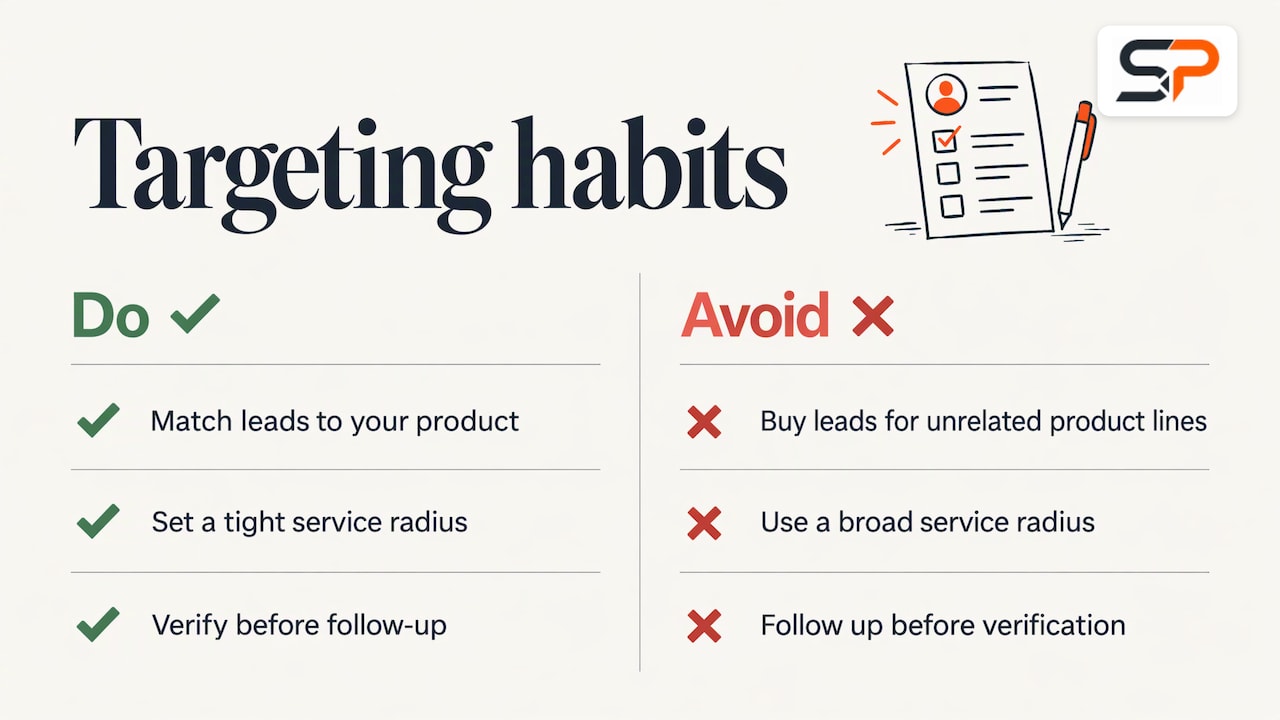
Better targeting lowers CAC by removing the leads you would not have closed anyway. Three habits do most of the work.
Match the lead to your actual product. An agency that writes Medicare policies gains nothing from a lead looking for crop coverage. Industry-specific campaigns attract people already looking for what you sell. Our Policy Engine sorts insurance leads by line, from P&C to Medicare to commercial and crop, so you pay for the market you work.
Set geography tightly. A narrower service radius reduces total lead volume, but a higher share of those leads can be served. For contractors this is often the cheapest improvement available. If you advertise on Meta, our guides to HVAC Facebook ads and HVAC lead generation show how to aim the campaign at booked jobs rather than clicks.
Verify before you follow up. Lead verification checks that the contact details and inquiry are real before your team spends time on them. It removes invalid inquiries from the pipeline so that your calling hours and your sequences go to people who can answer.
A worked example: what verified leads do to CAC
The figures below are an illustration, not a result we promise.
Say an insurance agency buys 100 leads in a month. In one scenario, 40 turn out to have bad contact details or no real interest, 60 are workable, and 6 of those become clients. In a second scenario, the agency pays only for verified leads and 100 are workable. Even at the same close rate of 10% of workable leads, that is 10 clients instead of 6.
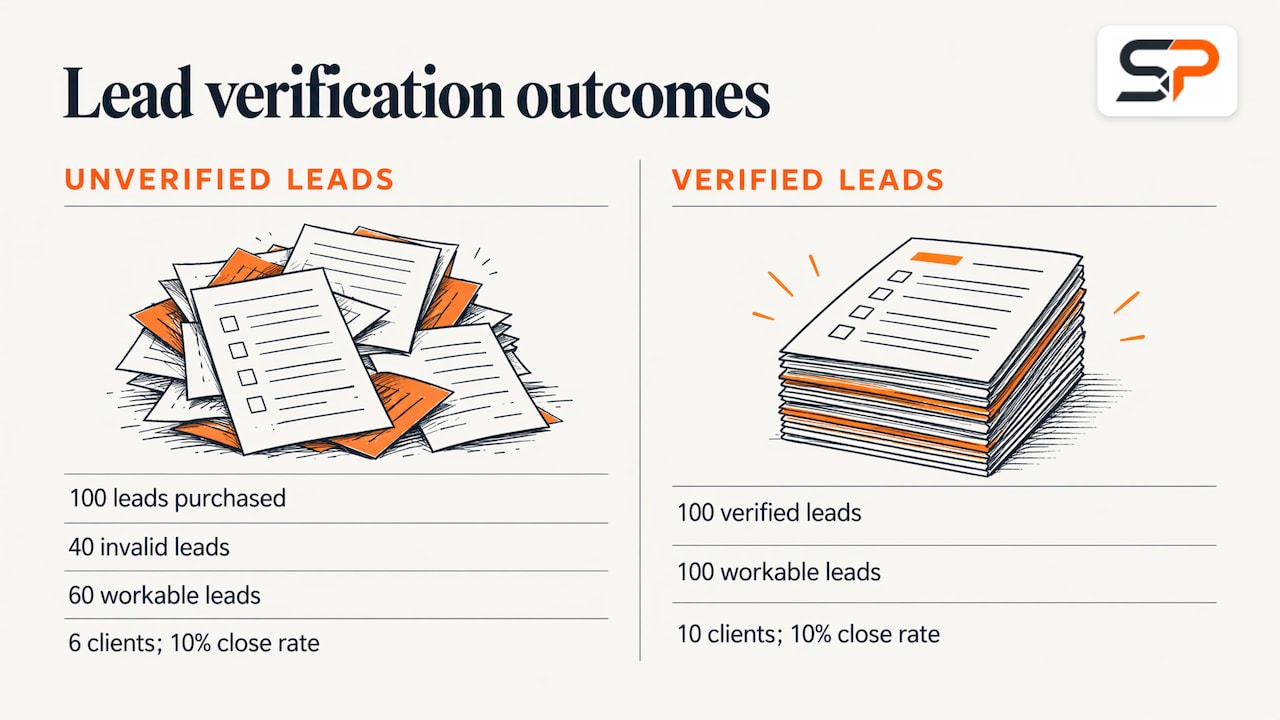
Our published per-lead fees show how simple the arithmetic gets. A verified P&C lead is $6, so 100 leads cost $600. If 10 become clients, lead cost per client is $60. Life leads are $8, Medicare $9, annuities $12, commercial $15 and crop $28 per verified lead. Higher fees reflect higher-value policies, so the right comparison is lead cost against commission per client, not fee against fee.
Note what this example leaves out. Your own time, CRM and any ad management belong in a full CAC. Add them, and the same logic applies: the more of your leads that are real, the further every fixed cost stretches.
Rank your channels by cost per customer
Once leads are tagged and tracked, compare channels on what they actually deliver:
| Metric | What it answers | Why it matters |
|---|---|---|
| Cost per lead | How cheaply does this channel produce inquiries? | Useful, but easily gamed by low-quality volume |
| Cost per qualified lead | How cheaply does it produce people who can buy? | Exposes cheap leads that never convert |
| Cost per appointment or quote | How cheaply does it produce a real sales conversation? | Shows where follow-up is breaking down |
| Cost per customer (CAC) | What does a signed client or booked job cost? | The number that pays the bills |
BizScout's small-business benchmarks put cost per lead at roughly $5 to $50 for low-cost channels, $40 to $200 for paid search, and $0 to $20 for referrals and organic. These are broad ranges from one source, and your trade and market will differ, so use your own CRM data as the real benchmark. Referrals and repeat business nearly always sit at the cheap end of any CAC comparison, so keep asking for them even while you run paid campaigns.
Check that a lower CAC is a better CAC
A falling CAC can be a warning sign. If you cut spend and the leads who do arrive are smaller accounts who leave quickly, you saved money on the wrong customers. A Harvard Business School background note on measuring CAC makes this point: CAC is a managerial judgment, not a mechanical ratio, and it should be read alongside customer value, retention and payback rather than treated as good simply because it is low.
The usual companion measure is the ratio of customer lifetime value (LTV) to CAC. Consumers Credit Union gives an example: a $300 CAC against $900 of lifetime revenue is a 3:1 ratio, generally considered healthy. A ratio of 1:1 or 2:1 suggests acquisition costs too much for what a customer is worth, while a very high ratio can mean you are under-investing in growth.
Here is how the three measures translate by trade:
- Insurance: LTV depends on policy type, premium and renewal commissions. A renewing P&C or Medicare book can justify more spend per client than a one-time sale.
- HVAC: a single install is valuable, but maintenance agreements and repeat service raise lifetime value. Count them.
- Commercial cleaning: contracts recur, so retention drives LTV. A client who stays for years can justify a much higher acquisition cost.
- MSPs: monthly recurring revenue makes LTV long and predictable, so payback period (months to recover CAC) is the number to watch.
Review CAC, LTV and payback every quarter, and change one variable at a time so you know what worked.
Build the follow-up engine once, then let it run
Speed and consistency are cheaper than extra ad spend, because they raise the yield of leads you have already paid for. A practical setup has four parts:
- Instant acknowledgment. An automated email, and an eligible text where the lead has consented, goes out within minutes of the inquiry. This is the five-minute standard we built our follow-up around.
- A written sequence. Three to five touches over a couple of weeks, each with a single clear next step such as booking a call, a site visit or a quote review.
- Pipeline stages with owners. Every lead sits in one stage, and every stage has someone responsible for moving it.
- Appointment tracking. If appointments are being set but not held, or held but not closed, you see exactly where the cost per customer rises.
If you sell insurance, our guide to insurance appointment setting covers the sequence in detail, and the one on commercial insurance prospecting applies the same pipeline logic to business accounts.
Where our system fits
Our platform is built for the four businesses this article addresses, and each has its own entry point.

Insurance agents can start with the Policy Engine: an email starter pack is $79 one-off, an email plus text starter is $97 one-off, and verified leads are billed per lead at the fees above. Done-for-You Meta Ads Setup is $297 one-off for agents who want the campaign built for them. You keep control of your own ad account and pay Meta directly.
HVAC contractors can look at Contractor Engine, which pairs industry-specific campaigns with the CRM follow-up described above. Commercial cleaning companies can see the Starter and Launch plans on the cleaners page, and MSPs can review MSP Growth. Pricing for those plans is not published, so the pages are the place to start.
Across all of them, the logic is the same one this article has followed: verified, industry-specific leads going in, a CRM pipeline that tracks every step, and rapid consent-based follow-up so more of what you pay for turns into customers.
What to do this month
- Calculate your CAC for the last full quarter and write down what you included.
- Tag every lead in that period as qualified or disqualified, and work out cost per qualified lead by channel.
- Measure how long your average new lead waits for a first reply. If the answer is hours, that is your first fix.
- Write a three-to-five touch follow-up sequence and automate the first message.
- Compare CAC with lifetime value and payback before deciding which channel gets more budget.
FAQ
What is a good customer acquisition cost for a service business?
There is no universal figure, because it depends on what a customer is worth. A common rule of thumb is a lifetime value at least three times CAC. Compare your CAC with your own average job or policy revenue and renewal history rather than with another industry's average.
What is the fastest way to reduce customer acquisition cost?
For most lead-driven businesses it is faster first contact and a structured follow-up sequence. Both raise the number of customers from leads you have already paid for, so they lower CAC without touching your ad budget.
What is the LTV to CAC ratio?
It is customer lifetime value divided by customer acquisition cost. A $900 lifetime value against a $300 CAC gives 3:1, which is generally treated as healthy. Much lower suggests acquisition costs too much; much higher may mean room to spend more on growth.
Should I stop paying for leads if CAC is too high?
First separate lead quality from lead cost. If many leads are invalid, out of area or the wrong product, verification and tighter targeting usually fix more than cutting spend. Judge each channel by cost per customer over at least a quarter before making a cut.
Sources
- TechTarget: Customer acquisition cost (CAC): How to calculate and reduce it
- American Marketing Association: CAC Calculator
- Shopify: How to Calculate CAC
- BizScout: How to Analyze Lead Generation Channels
- Questic: Small Business Statistics 2026, Follow-Up Gap Report
- Flowout: B2B Landing Page Best Practices
- Harvard Business School: Measuring Customer Acquisition Cost (CAC)
- Consumers Credit Union: Know Your Cost of Acquiring Customers